
Why a Cruise Proposal Is Not a Hotel Quote
You have built this proposal before. Not this one exactly, but its shape: the ship, the sailing, three cabin categories with prices, what the deposit is, when the balance is due, what happens if they cancel in September rather than November. You are building it again in a document, because the tool you have produces a quote and what this client needs is not a quote.
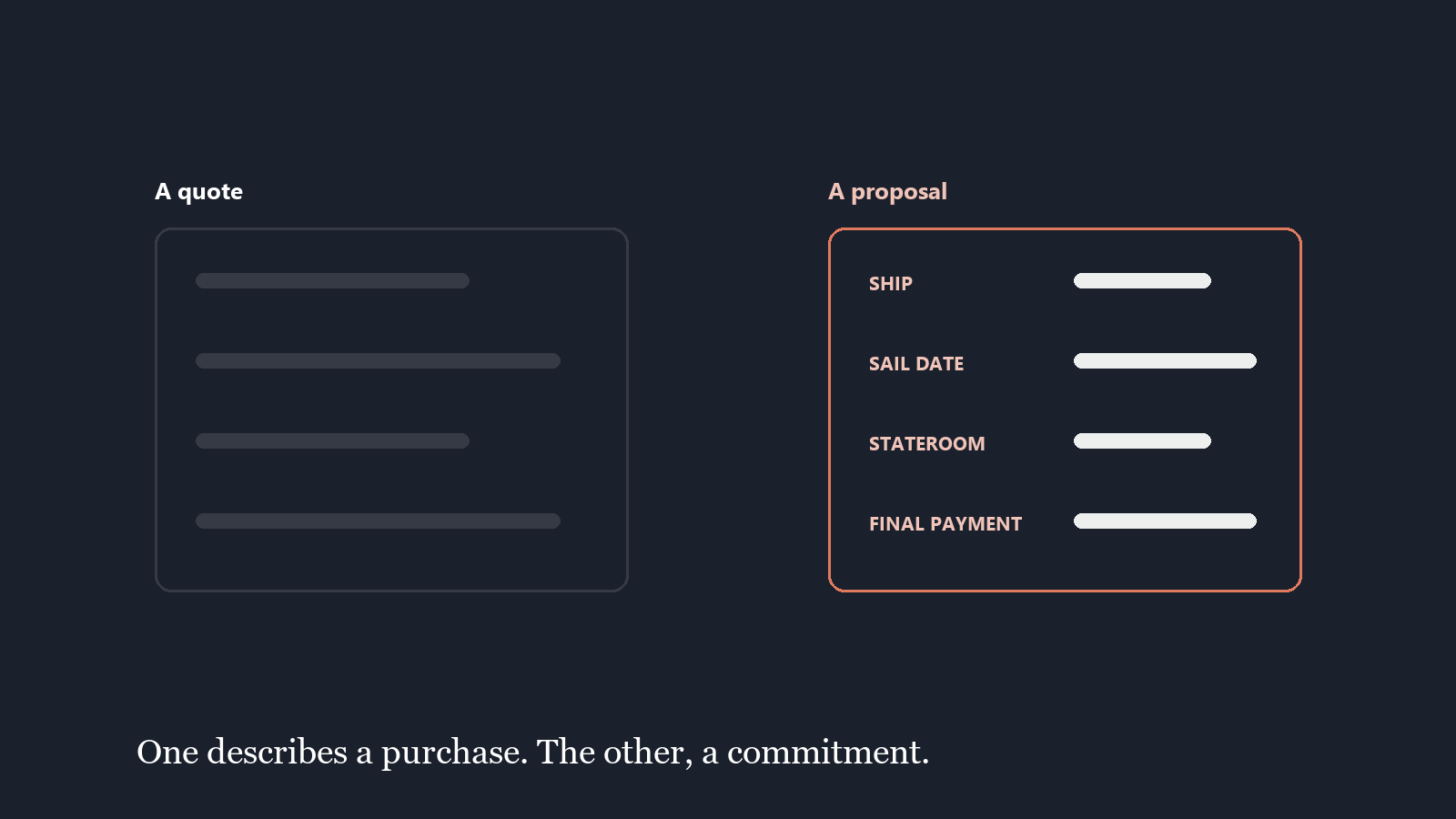
The difference between the two is not length or polish. It is that a hotel quote describes a purchase and a cruise proposal describes a commitment with a schedule attached.
What a hotel quote contains
A hotel quote is close to complete when it names a property, some dates, a room type and a total. The client reads it, decides, and pays. If they change their mind two weeks later, the answer is usually a cancellation policy that fits in one sentence.
That is a genuinely simple product, and tools built around it are not badly made. They are made for something else.
What a cruise proposal has to carry that a quote does not
The itinerary is the product. Nobody buys "seven nights in the Caribbean". They buy a specific sequence of days: which ports, in which order, which days are at sea, when the ship is where. Two sailings on the same ship in the same week at the same price are different products, and the difference is the itinerary. A proposal that omits it has left out the reason to choose.
Cabin categories are not room types. A room type is a description of a room. A category is a rung on a fare ladder, and it carries meaning beyond the physical cabin — location on the ship, which deck, proximity to lifts and to noise, occupancy rules, what is bundled. Clients frequently choose between three categories on the same sailing, and the proposal has to make that choice legible. Substituting "room type" collapses the ladder into a name and takes the decision away from the person making it.
The schedule of obligations. A cruise proposal has to state what is owed and when: the deposit and whether it is refundable, the final payment date, and the cancellation penalty bands with the dates they apply from. This is the part most often left out and the part most often needed. A client asking what happens if a travelling companion is not well enough by October is asking a question with an exact answer, and the exact answer is a date range.
Occupancy and the party. Cruise fares are per person with occupancy rules. A third or fourth guest in a stateroom is priced differently and constrained by which cabins allow it. A proposal for a family is not a proposal for a couple with a bigger number on it.
Why hand-built proposals decay
Assembling this in a document works. It works the first time, and it works badly by the twentieth.
The document goes stale. Fares move, and a proposal sent on Tuesday quoting Monday's price is a conversation you will have to have. Terms drift — the cancellation wording gets copied from an older proposal for a different line, and now it is wrong in a way nobody notices until it matters. And every proposal is a re-entry of data that already exists somewhere, which means every proposal is a fresh opportunity for a wrong sail date or a transposed cabin number.
There is a quieter cost too. Because assembling one takes real time, you send fewer. A client who is undecided between two sailings gets one proposal instead of two, because building the second is thirty minutes you do not have.
Generated from the booking data, with the terms as blocks
Travel Agent Companion generates quotes and proposals from the records rather than from a blank page, using templates with terms blocks.
Two parts of that are worth separating. Generating from records means the ship, the sailing, the sail date, the itinerary and the stateroom category come from the same place the booking will, so the proposal cannot disagree with the booking. Re-entry is where proposals go wrong, and there is no re-entry.
Terms blocks are the other half. Deposit terms, cancellation bands and line-specific conditions are maintained once and inserted, rather than copied forward from whatever document was nearest. That is what stops a Celebrity cancellation schedule appearing on a Princess proposal — which is the kind of error that is embarrassing at best and expensive at worst, and which is almost impossible to avoid when the source of truth is the last proposal you happened to open.
Because the pipeline holds quotes and proposals as stages rather than as attachments, sending a second option to an undecided client is a variation rather than a rebuild. That is the change that actually shows up in conversions, and it is a change in effort rather than in persuasion.
What a cruise-shaped template looks like
If you are building your own, the order that works follows the decision the client is making.
Open with the sailing itself: ship, line, sail date, and the itinerary laid out day by day with ports and sea days. Then the categories being offered, side by side, with what distinguishes them stated in terms the client can act on — deck, location, whether the balcony is worth the difference for this itinerary. Then the money: fare per person at the chosen occupancy, what is included, what is not. Then the schedule: deposit, final payment date, cancellation bands with dates. Then, briefly, what you will do — the part a direct booking does not come with.
Everything above the money is the recommendation. Everything below it is the commitment. Clients read them differently, and a proposal that mixes them makes both harder.
Travel Agent Companion is free during early access. If you are rebuilding the same proposal in a document each week, join the waitlist.