

Keeping Your Book of Business Portable
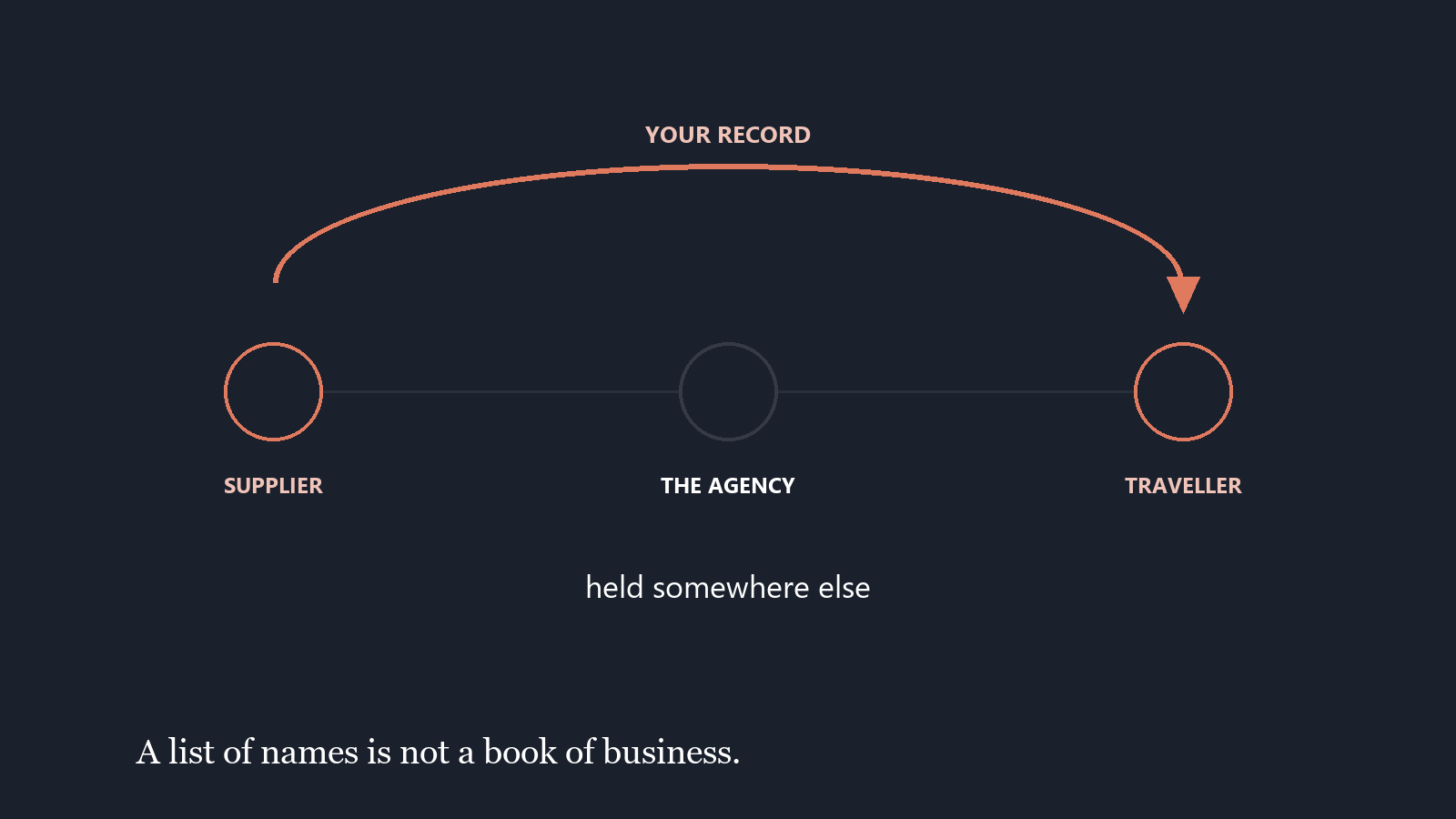
Here is a question most independent agents have not asked precisely, because the answer is uncomfortable and rarely urgent until it is: if you moved to a different host agency next month, what would you take with you?
Not what you would be permitted to take in principle. What would actually arrive on the other side, in a form you could use, in the week you needed it.
The tool belongs to the host, and so does the shape of your record
Working under a host agency is a good arrangement for most independent agents. It supplies the accreditation, the supplier relationships, the commission rates you could not negotiate alone, and often the booking systems.
That last item is the one worth examining. When the host provides the CRM, the client list lives in a system the host operates, under terms the host sets. This is not sinister and usually not adversarial. It is simply the arrangement, and the arrangement has a consequence that only becomes visible at the exit: the record of your relationships is held in somebody else's software.
Ask what "your data" means concretely in that setting and the answers vary enormously. Sometimes it means a CSV of names and emails. Sometimes it means a report you can print. Occasionally it means a complete export including booking history and commission records. The difference between the first and the last is the difference between starting over and moving.
What portable actually has to include
A list of names and email addresses is not a book of business. It is a mailing list, and it is the part of the relationship that is easiest to replace.
The parts that carry value are the ones that took years to accumulate.
Booking history. What each client has sailed, on which line, in which category, at what fare, and when. This is what lets you recommend rather than guess, and it is what makes a repeat client a short conversation.
Preferences. Deck, dining, mobility requirements, who they travel with, what they will not accept again. Losing these means asking a returning client questions they already answered, which is the fastest way to feel like a stranger.
Commission records. What was earned, on what, and whether it was paid. Without this you cannot reconstruct what the business has actually been worth, and you cannot chase anything outstanding at the moment you leave — which is precisely when things go unpaid.
The travelling party structure. Who belongs with whom. Cruise is sold to households and groups, and a flat contact list loses the shape entirely.
If an export gives you the first item and not the rest, you have your contacts and none of your context.
The questions to ask before you enter another client
Four, and they are all fair to ask of any system, host-provided or bought.
Is a full export available on demand, without asking anyone? Self-service matters. An export you have to request is an export that can be slow at exactly the moment relations are strained.
Does the export include booking history and commission, or only contacts?
What format? A CSV you can open is usable. A PDF report is a picture of your data.
Is your data separated from other agencies' data, or pooled? Pooled storage makes clean extraction genuinely difficult even when everyone is acting in good faith.
The right time to ask is now, not later. The answers do not change, but your leverage does.
Where Travel Agent Companion stands, and how to check it
The platform is built so the book of business sits on the agent's side of that line. Contacts, booking history and commission records are exportable in full. Isolation is per agency and never pooled, enforced at the database rather than by convention, which is what makes a clean extraction possible rather than merely permitted.
The practical consequence is the one that matters at a host agency change: the client list, what they sailed, what they prefer and what you earned all come with you, because they were yours and stored as yours.
This is a claim you should verify rather than accept, and it is verifiable in about a minute — ask for the export and see what comes out. That is a reasonable thing to do before committing a book of business to any system, including this one. A vendor who is confident about portability will not mind the question. The reaction to being asked is itself informative.
If you are already deep in someone else's system
Most agents reading this are not choosing from scratch. They are several years into an arrangement, with a client list that lives somewhere they do not control.
The useful move is not to leave. It is to stop the gap widening. Ask for the export now, while nothing is at stake, and look at what actually arrives — that single act tells you more than any policy document, and it tells you it at a moment when nobody is wondering why you asked.
Then keep the parts that are genuinely yours somewhere you hold. Preferences, what each client sailed, what they said afterwards, what you are owed. None of that requires leaving your host, and all of it is the material that would otherwise have to be reconstructed from memory.
The switching cost nobody quantifies until they face it
The reason this sits unexamined is that the cost is invisible while you stay.
It becomes visible in a specific week: the one where you have decided to move and discover that eleven years of who-sailed-what is available as a name-and-email list. At that point the work is manual reconstruction from memory and old emails, done while also running a business, and most of it simply does not get done. The relationships survive. The knowledge about them does not.
That asymmetry is why portability is worth caring about before it is urgent. It costs nothing to check now and cannot be fixed later.
Travel Agent Companion is free during early access. If you are not certain what would come with you, join the waitlist.