
What Makes a CRM Cruise-Native
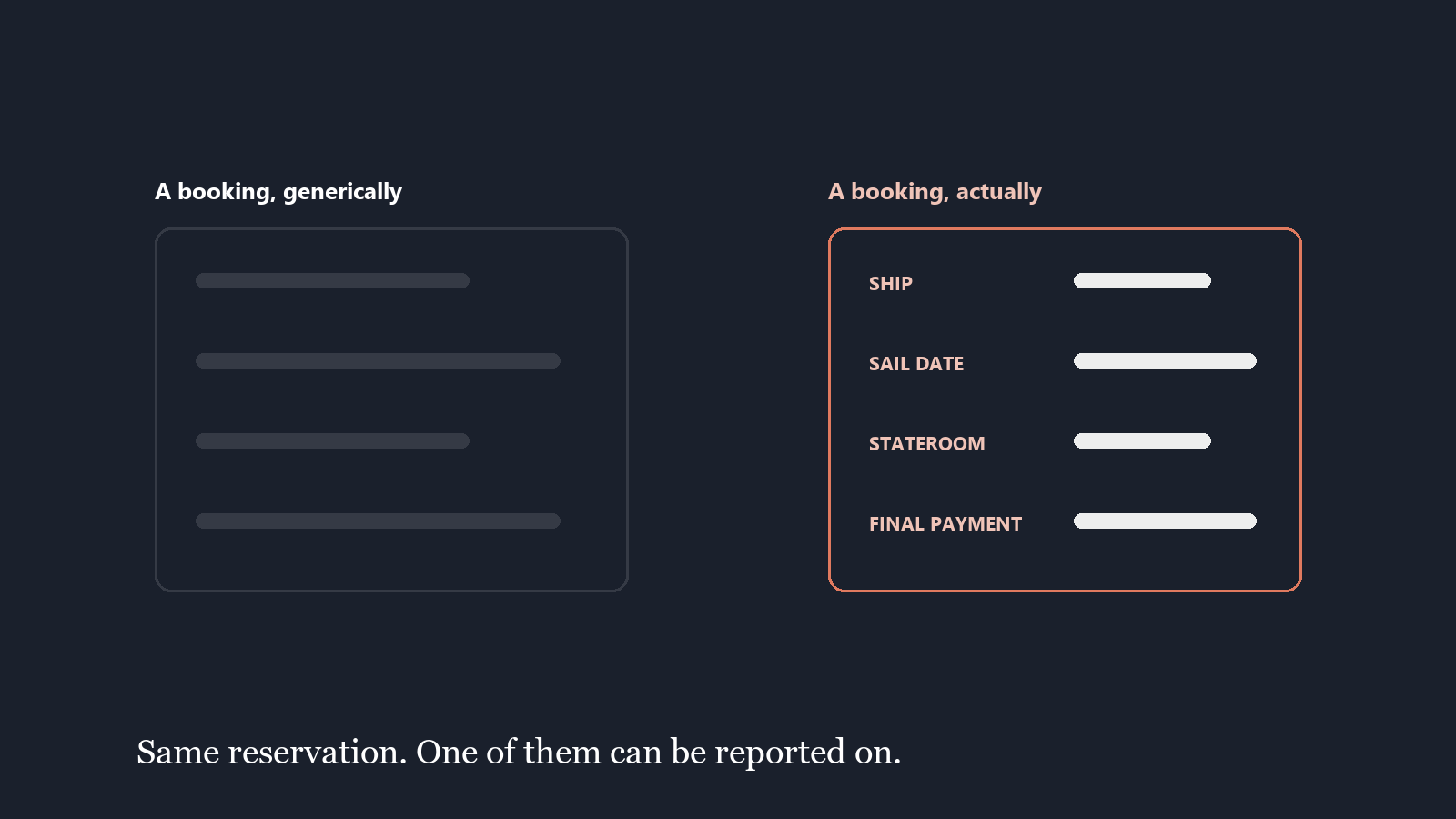
Most travel CRMs demo well. The contact list looks sensible, the pipeline has stages, the emails send. The trouble starts at the first booking you try to enter, when you look for somewhere to put the sail date and find a field called "start date", and somewhere to put the stateroom category and find a field called "room type".
Those are not cosmetic mismatches. They are the visible edge of a data model that was built for a hotel stay, and everything downstream inherits the shape.
The test is what the system stores as a first-class record
There is a quick way to establish whether a system is cruise-native, and it takes about four minutes in a demo. Ask whether each of these exists as its own record, with its own fields, rather than as text you type into a general-purpose box.
The cruise line. Not a supplier name in a free-text field. A record, so that commission terms, payment schedules and policies can attach to it.
The ship. Ships have attributes that matter to a recommendation and to a client's experience — size, layout, which line operates it, when it was last refitted. A ship that is a string cannot carry any of that.
The sailing and its sail date. A specific departure of a specific ship on a specific date. This is the thing being sold. If it is not a record, nothing can attach to it.
The itinerary and its ports of call. An ordered sequence, not a destination. "Caribbean" is not an itinerary and cannot be used to answer a client asking whether the ship is in Cozumel on a Tuesday.
The stateroom category. Categories are not room types. They are a fare ladder with rules about occupancy, location and what is included, and the same physical cabin can sit in different categories on different sailings.
If the answer to any of those is "you can put that in the notes", the system is a hotel booking with extra fields, and the mismatch will not improve with familiarity.
What breaks downstream, and it is never the data entry
The data entry is the least of it. Typing a sail date into a field called "start date" is mildly irritating and takes no extra time.
What breaks is everything that needs to reason about the data afterwards.
Deadlines. Final payment for a cruise is derived from the line and the voyage length. If the system does not know which line, or how long the sailing is, it cannot compute or check a deadline. It can only store whatever date you typed, which means the date is only ever as right as your last calculation.
Reporting. "which lines do you actually sell" and "what is your average commission by line after the split" are unanswerable if the line is free text with four spellings. You will find out that Royal Caribbean, RCI, Royal, and RCCL are four different suppliers according to your own reports.
Proposals. A cruise proposal has to state the itinerary, the cabin category, the deposit terms and the cancellation bands. If none of those are structured, every proposal is assembled by hand from a blank document, every time.
Groups. A group is a contract against a specific sailing with cabins under it. Without a sailing record there is nothing for the group to attach to, so groups become a separate spreadsheet, which is where this started.
The pattern is consistent: a generic model does not stop you entering the booking. It stops you doing anything with it later.
Reference data is the part nobody asks about and everybody needs
The second question worth asking in a demo is where the ships and ports come from.
Cruise-native means the system already knows the fleet — lines, ships, ports, destinations — rather than expecting you to type them. That sounds like a convenience and is actually a correctness feature. Shared reference data is what makes "every Celebrity booking" a reliable query instead of a search that misses the ones where you typed it differently on a Friday.
It is also what makes port and destination content possible at all. If your agency website is going to say anything useful about a port of call, something has to hold what that port is.
Where Travel Agent Companion sits
The platform models ships, cruise lines, itineraries, ports of call, sail dates and stateroom categories as first-class entities in the schema and in its reference data, rather than as custom fields on a generic booking. Commission is modelled on cruise terms. Groups attach to sailings, with their own cabins and deadlines.
That is the whole claim, and it is a claim you can check rather than take on trust. Ask for the booking screen. Look for whether the sail date, the ship and the stateroom category are fields with meaning or boxes with labels.
The reason to check rather than believe is that this is the one thing a neighbouring product cannot retrofit quickly. Adding a field is an afternoon. Changing what a booking fundamentally is, after years of agencies depending on the old shape, is not.
The questions to ask in any demo
Five, in this order, and they take under ten minutes.
Enter a fourteen-night sailing and a three-night sailing. Does the system know their final payment dates differ?
Ask for every booking on one ship next spring. Is that a query or a search?
Ask what happens when a fare drops before final payment. Is repricing a concept, or an edit?
Create a group. Does it attach to a sailing, or is it a tag?
Ask to export everything. Note whether the answer is immediate.
A system built for your job answers all five without an apology. Anything else is asking you to adapt your work to its model, which you will do, and which will cost you a little every day for years.
Travel Agent Companion is free during early access. If you are comparing systems, join the waitlist.