

Never Miss a Cruise Final Payment Deadline Again
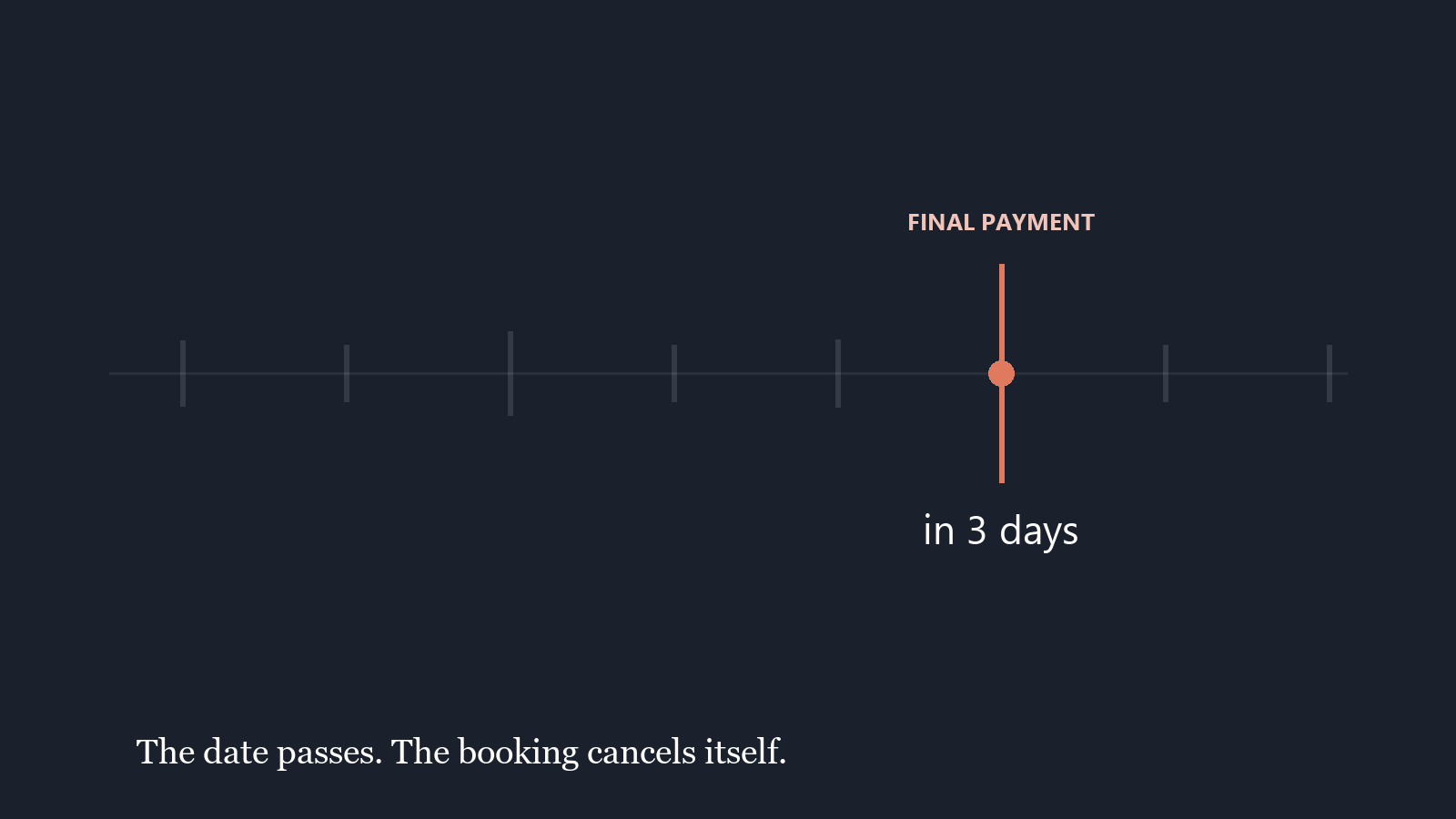
A final payment date is the only deadline in this job that cancels the sale by itself. Nobody has to decide to cancel it. The date passes, the system acts, and a booking you worked for months is gone — along with the deposit in many cases, and along with a client conversation that will not be pleasant.
Every independent agent knows this. Almost every independent agent still tracks those dates somewhere fragile.
The deadline is a property of the sailing, not of cruising
The reason a simple reminder habit fails is that there is no single number to remember.
Final payment commonly falls somewhere between sixty and ninety days before departure, but the actual figure depends on the line and on the length of the voyage. Royal Caribbean publishes seventy-five days for sailings of one to four nights, ninety days for five to fourteen, and one hundred and twenty days for fifteen or more. Disney Cruise Line splits at a different point: ninety days for five nights or fewer, one hundred and twenty for six or more. Holiday sailings and longer international itineraries frequently sit earlier still.
Then the fare moves it again. A promotional rate can carry its own payment terms. A group contract has review dates of its own that are unrelated to the individual final payment. A refundable deposit and a non-refundable deposit on the same sailing behave differently when the date arrives.
So the deadline for the booking in front of you is a function of at least four things: the line, the voyage length, the fare code, and whether it sits in a group. That is a small calculation, and it is a calculation nobody performs reliably at eleven at night across thirty live bookings.
Missing it is not the only failure
There is a second, quieter cost that comes from the same weakness, and it is money rather than embarrassment.
The window before final payment is the window in which a booking can usually be repriced. If the fare drops in that period, most lines will honour it in some form — the lower fare, onboard credit, or a category upgrade. After final payment the options narrow sharply, typically to a credit or an upgrade rather than anything refundable.
That means the same date governs two opposite things. Before it, you have leverage and a reason to be watching. After it, you have neither. An agent who is not tracking the date is not just at risk of a cancellation; they are systematically missing the only period in which they could have delivered a client several hundred in value for a five-minute call.
Cancellation penalties work on the same clock. They step up in bands as the sailing approaches, so the cost of a client changing their mind depends entirely on which week they change it. A client asking "what happens if we cancel" deserves an exact answer, and the exact answer is a date range lookup, not a guess.
The reminder chain that actually holds
Three layers, and the third is the one most agents lack.
The client. They should know their date and be reminded ahead of it, far enough out that they can move money. A reminder that arrives the day before is not a reminder, it is a notification of a problem.
You. A working view of what is due in the next fortnight, checked on a rhythm rather than remembered.
Something that does not depend on either of you. This is the layer that matters. Both of the first two fail in exactly the same circumstances — illness, holiday, a busy fortnight, a client who changes email address. A deadline that only exists in a person's attention is not tracked; it is being gambled on.
The date as a field, not as a calendar entry
Travel Agent Companion holds the deadline on the booking itself, alongside the sailing, the ship, the stateroom category and the fare, because that is what it is an attribute of. A reservation queue surfaces what is approaching rather than waiting for you to go looking.
The difference from a calendar is not convenience, it is correctness. A calendar entry is a copy, made at a moment in time. When a booking is repriced, moved to a different sailing, or brought into a group, the calendar entry does not know. The field does, because there is only one of it.
The same structure is what makes the fortnight view possible at all. "Every booking with a final payment inside the next fourteen days, and whether it is paid" is a question you can only ask if the deadline is structured data on a booking rather than text in a cell or an event in an unrelated application.
Group deadlines cascade from the contract rather than from the individual booking, which is why they need to be held as their own dates rather than inferred. The platform tracks group deadlines separately for that reason.
What to do this week
Take your live bookings that have not reached final payment. For each, confirm the date against the line's actual schedule rather than your assumption, note whether the deposit is refundable, and check whether the current fare is lower than what was paid.
That last check is the one that pays for the exercise. It is also the one nobody does, because doing it requires exactly the list that is hard to produce.
Travel Agent Companion is free during early access. If your final payment dates live in your head, join the waitlist.