

Tracking Cruise Commission From Deposit to Final Payment
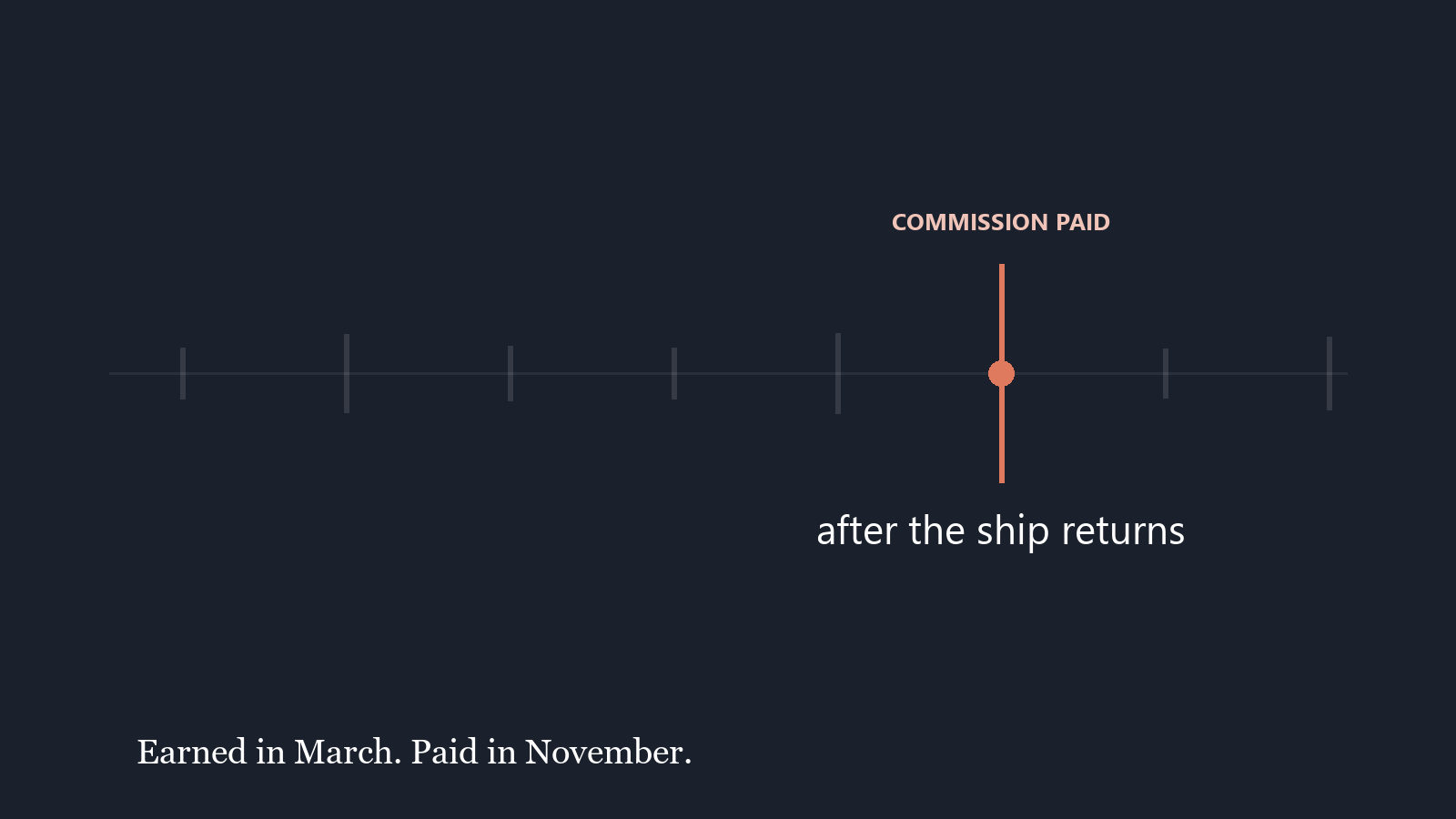
Here is a question worth asking yourself before reading further: what are you owed right now, across every sailing you have booked that has not yet paid out? Not roughly. The number.
Most independent agents cannot produce it in under an hour, and many cannot produce it at all. That is not carelessness. Cruise commission is genuinely harder to track than commission in almost any other kind of travel, for reasons that have nothing to do with how organised you are.
The money moves at three separate moments, and none of them is the sale
A cruise booking pays out on a schedule that is disconnected from when the work happened.
The client pays a deposit, which is often refundable and sometimes not depending on the fare. Months later they pay the balance. Then, depending entirely on the line, commission is released to your host agency — and the release point is not standardised. Princess disburses to agencies within about sixteen days of final payment. Regent issues payment around four weeks before the sail date. A number of lines pay only after the guest has actually travelled.
So for a sailing you booked in March, departing in November, the commission might arrive in September, in October, or in December. Three different bookings made in the same week can pay in three different quarters.
Then there is a second split. The supplier pays your host agency, and your host agency pays you. Splits vary widely across the industry — 70/30 in the agent's favour is a common shape, with the range running from roughly 60/40 to 95/5 depending on the host and on volume. Your actual take is the fare, times the supplier's commission rate, times your split.
Nothing about that sequence is difficult to understand. What makes it hard is that it produces a long, overlapping queue of amounts owed at different times by different parties, and a spreadsheet row records only the moment you typed it.
The number nobody can produce is expected against paid
The practical failure is not that agents lose commission outright. It is that the reconciliation never happens.
A host agency statement tells you what was paid. It does not tell you what should have been paid, because it has no view of what you expected. Comparing the two requires a record of every booking, its fare, its commission rate, your split, and its expected release timing — held somewhere that can be sorted and totalled.
Without that, three things go unnoticed. A booking that paid at the wrong rate. A booking that was cancelled or repriced where the commission silently changed. And a booking that simply never paid, which is the one that hurts, because there is no alert for money that does not arrive. Nobody sends a notification saying a payment failed to happen.
The gap is also invisible in both directions. Agents who track loosely often assume they are being underpaid and cannot prove it, or assume everything is fine and have no basis for that either.
What to record, and at which of the three moments
The discipline is small if it happens at the right times.
At booking. Fare, the supplier's commission rate, your split, the line, and the sail date. The sail date matters because it is what determines when to expect payment for most lines.
At final payment. Whether the fare changed. Repricing before final payment is common and legitimate, and it moves the commission with it. A booking repriced downward that still shows the original expected commission will look like an underpayment later.
At payout. What actually arrived, against what was expected. This is the step that gets skipped, and it is the only one that turns a record into a reconciliation.
None of that requires software. It does require that all three moments write to the same record rather than to three different places, which is exactly what a second spreadsheet cannot do.
Commission as a field on the booking, not a separate ledger
Travel Agent Companion tracks commission on the booking itself rather than in a parallel system. The rate, the expected amount and its status live with the sailing they came from, alongside the fare, the stateroom category, the sail date and the final payment date.
Two things follow from that, and they are the whole argument.
The first is that expected against paid becomes a query rather than an exercise. Everything booked, everything outstanding, everything overdue by sail date — those are views of one set of records, not a monthly assembly job.
The second is that a change in one place changes the number everywhere. When a booking is repriced, the commission expectation moves with it, because it is an attribute of that booking and not a figure copied into a different file three months ago. A separate commission spreadsheet is always a snapshot of what was true when you last updated it, and the gap between that snapshot and reality is where the missing money lives.
Commission reporting sits on the same records, which means the question "what this client has earned over four sailings" has an answer, and so does "which line actually pays best after the split", which is a different question from which line advertises the best rate.
Start with what is already in flight
If you want to begin, do not reconstruct history. Take the bookings that have not yet paid out, record the four fields above for each, and add the payout check as a habit when statements arrive.
Within one cycle you will have something most independent agents never have: a number you can state with confidence when someone asks what the business is owed.
Travel Agent Companion is free during early access. If you cannot currently say what you are owed, join the waitlist.