

Your Cruise Bookings Have Outgrown Your Spreadsheet
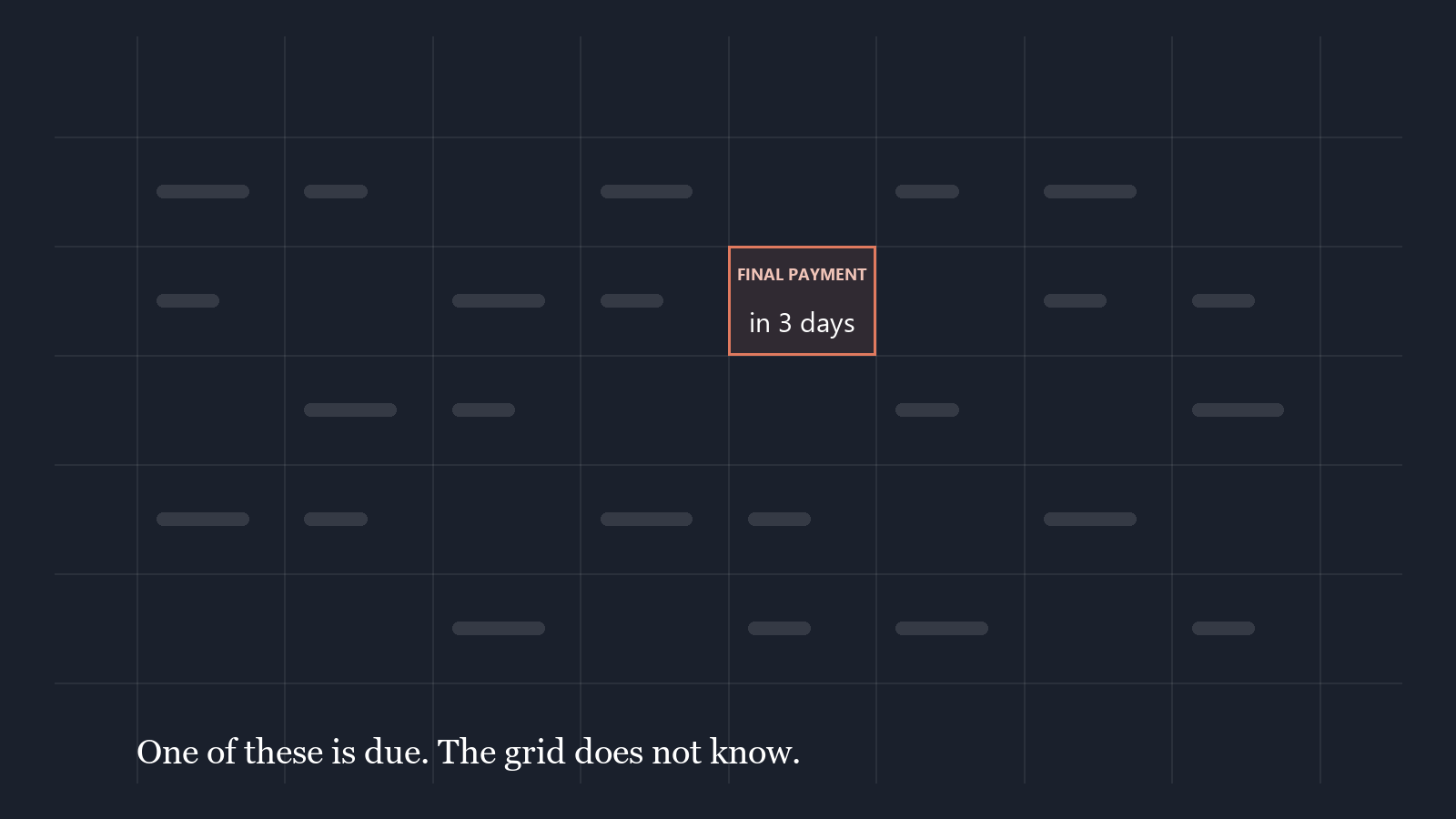
A client calls on a Tuesday afternoon to ask whether they can still add their sister to the second stateroom. You know the answer is somewhere. It is in the confirmation email from the cruise line, or in the tab where you tracked that booking, or in the note you made when the group first came together in March. While they wait, you scroll.
The spreadsheet is not the problem. The spreadsheet was a reasonable decision, and for a while it was the right one. The problem is that a cruise booking is not the kind of thing a row can hold, and the gap between those two shapes widens with every sailing you sell.
A cruise booking is a set of dated obligations, not a record of a sale
A hotel reservation is close to a single fact: a room, some nights, a price. It is finished when it is made.
A cruise booking is not finished when it is made. It is a set of promises that fall due on different dates, and most of those dates are not the sail date.
There is a deposit, which may be refundable or not depending on the fare. There is a final payment, and if it passes unpaid most lines cancel the reservation automatically. There is a window in which a name can still be changed on a stateroom, and one after which it cannot. There are cancellation penalty bands that step up as the sailing approaches, so the cost of a client's change of heart depends entirely on which week they have it. There is the date the group block is reviewed and unsold cabins go back. And there is commission, which arrives after the ship returns.
None of those dates is the same across your book of business. Final payment is commonly somewhere between sixty and ninety days out, but the actual number depends on the line and on the length of the voyage. Royal Caribbean publishes a schedule of seventy-five days for sailings of one to four nights, ninety days for five to fourteen, and one hundred and twenty days for fifteen or more. Disney Cruise Line splits at a different point, ninety days for five nights or fewer and one hundred and twenty for six or more. Holiday sailings and longer international itineraries often sit earlier still.
So the deadline is not a property of cruises. It is a property of this cruise, derived from the line, the voyage length, the fare code and whatever promotion applied on the day it was booked. A column called "final payment" can hold that date. What it cannot do is work it out, or tell you when it is close.
The booking keeps changing after you have written it down
The second thing a row struggles with is that the record does not stay still.
Fares move. If the price drops before final payment, the reservation can usually be repriced, and the remedy varies by line and by timing: sometimes the lower fare, sometimes onboard credit, sometimes a category upgrade. After final payment the options narrow, and the answer becomes a credit or an upgrade rather than money back. That is a real piece of value you can deliver for a client who would never have noticed the drop themselves, and it is only available if somebody is watching between the deposit and the final payment.
Staterooms move too. A guest is added or dropped. A cabin is assigned where only a category was held. A category is upgraded and the price and the penalty schedule change with it.
Every one of those events means finding the row and editing it. And an edited row keeps no memory of what it used to say. When a client asks in September what they agreed to in March, the spreadsheet can only tell you what is true now.
The failure is not losing data, it is having no idea what is due
Most agents who work this way do not lose bookings. They are careful, and the work gets done. What it costs is something less visible.
It costs the answer to a simple question: what is due in the next two weeks, across everything. A spreadsheet can be sorted by a date column, which helps, right up until the dates are of different kinds — this one is a final payment, that one is a name-change cutoff, the other is a group review date. Sorting a mixed column produces a list nobody can act on without opening each booking to remember what the date meant.
It costs the ability to hand the work over. A tracker is legible to the person who built it. Another agent, or a colleague covering a week of leave, cannot pick it up and know which colour means what, or which tab is current.
And it costs the reconstruction, every time. Answering the sister-in-the-second-stateroom question takes four minutes of scrolling and two files, when it should take one look.
What a booking record does that a row cannot
The alternative is not a better spreadsheet. It is a booking that knows what it is.
Travel Agent Companion models the things a cruise booking is actually made of as first-class records rather than as text in cells: the cruise line, the ship, the sailing and its sail date, the itinerary and its ports of call, the stateroom category, and the guests travelling in each stateroom. Because those are structured, the dates attached to them can be structured too — a final payment is a field with a date and a status, not a note.
That is the difference that matters. When a deadline is a field on a booking rather than a value in a column, it can be queried. Every booking with a final payment inside the next fortnight is a list the system produces, not one you assemble. Commission stops being a separate reconciliation spreadsheet and becomes something the booking carries from deposit through to payout. Booking history stays attached to the client, so what they agreed to in March is still readable in September alongside what changed since.
The platform was built by a founder who tracked cruise bookings in spreadsheets and sticky notes, tried the tools built for hotels, and found them priced above the commission on a balcony stateroom. The data model is the part that came out of that, and it is the part worth checking first.
What to move first
If you decide to move, the order matters more than the speed.
Start with live bookings that have not reached final payment, because those are the ones where a missed date has a consequence and where a repricing opportunity still exists. Then bring across the clients behind them, with whatever preference notes you have — deck, dining, mobility, who they travel with. Past sailings can wait; they are useful history, but nothing breaks if they arrive last.
You will notice quickly whether the model fits. If a system cannot hold a sail date, a stateroom category and a per-line payment schedule without you inventing a custom field for each, it was built for a different product and the mismatch will not improve.
Travel Agent Companion is free during early access. If your bookings have outgrown the tab they started in, join the waitlist.