
Running a Small Agency Like a Big One
A large agency answers a cruise enquiry in an hour. You answer the same enquiry well, and often better, in a day. The difference is not talent and it is usually not effort. It is that somebody at the large agency has already decided what happens to an enquiry, written it down, and built the thing that makes it happen without anyone remembering to.
That is what a big agency actually has. Not more people. Systems that carry work when attention is elsewhere.
The four systems that account for most of the gap
Strip away the enterprise software and the difference between a twelve-person agency and a one-person agency comes down to four things.
A shared record. One place where a client, their sailings, their preferences and their money all live. Large agencies have this because they must — a booking has to survive an agent being on annual leave. Small agencies often do not, because nobody else needs to read it, right up until somebody does.
A defined pipeline. An enquiry at a large agency is in a named stage, and the stages mean something: quoted, proposal sent, held, deposited. Nobody wonders what to do next, because the stage says.
Deadlines that act. Final payment dates, name change cutoffs and group review dates do not depend on a person remembering. The system holds them and raises them.
Reporting you can trust. How much is booked, what is outstanding, what commission is due and when. Not because a report is inherently valuable, but because you cannot make a decision about where to spend next month without one.
Every one of those is a system rather than a headcount. Which is the good news: they are the things a small agency can actually acquire.
What the gap costs a small agency, specifically
It is rarely a lost booking. It is a slower response while you find the last quote, a repeated question because the preference was in an email, a deadline held in your head instead of in a system, and a week of holiday where the business simply stops.
The last one is the one worth naming. If every live booking depends on your recall of it, you cannot be unavailable. That is not a scale problem or a growth problem. It is a working-conditions problem, and it is the one that tends to end small agencies rather than any commercial failure.
The stack is not the answer, and is usually part of the problem
The instinctive fix is to buy the pieces separately: a CRM for contacts, a quoting tool, a mailing platform, a spreadsheet for commission, a form builder for enquiries. Each is reasonable. Together they produce a specific failure that is easy to miss while it happens.
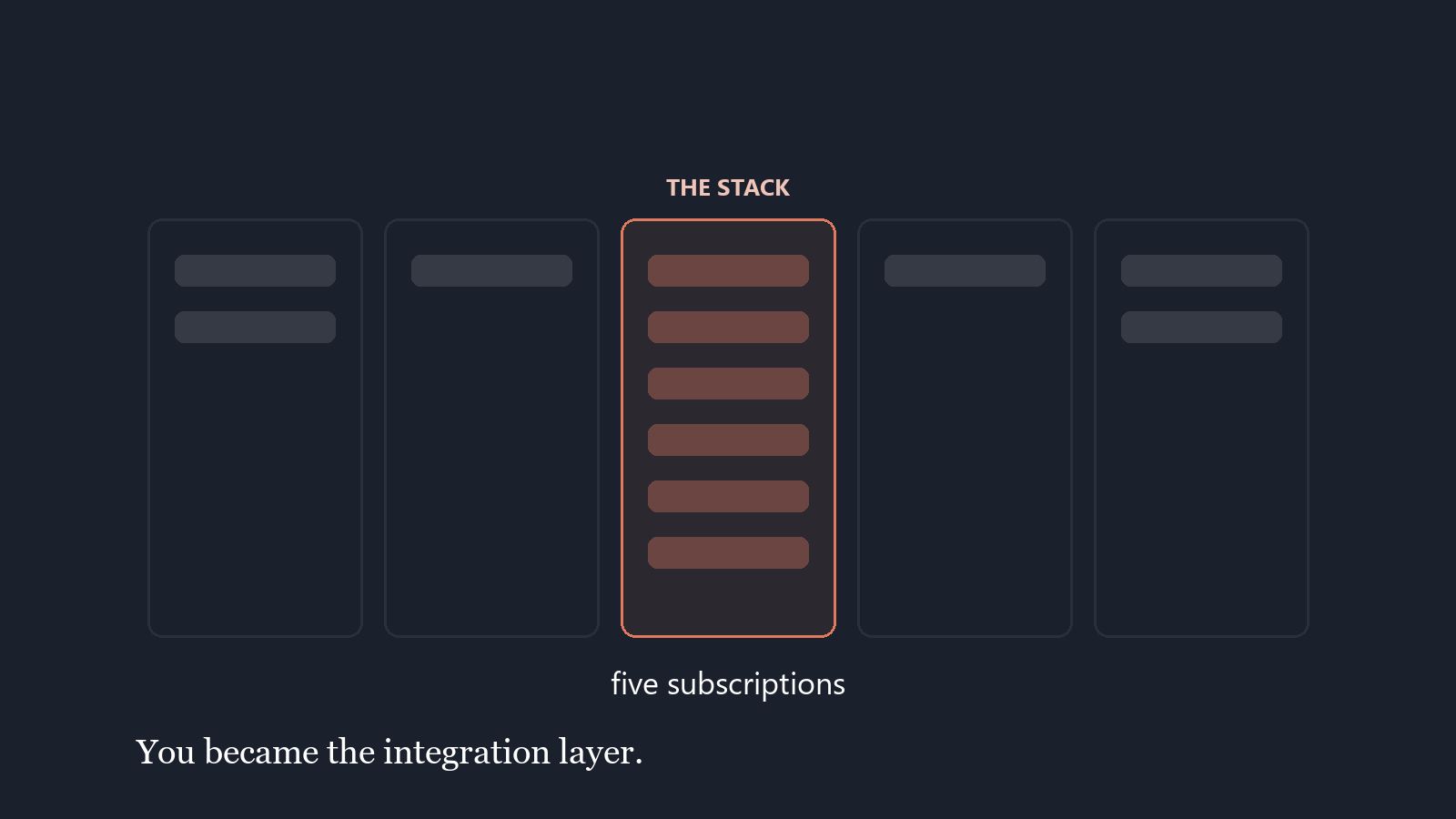
You become the integration layer. The client exists in four systems with four spellings. The booking is in one and the money is in another and neither knows about the deadline. Every question that spans two systems — what is this client worth, what is outstanding across everything, which enquiries went cold this month — becomes a manual exercise, so it stops being asked.
Large agencies get away with a stack because someone is paid to maintain it. A solo agent paying five subscriptions is paying for five systems and doing the integration work personally, unpaid, forever.
One platform, and the specific thing that changes
Travel Agent Companion is one system rather than a stack: contacts and lead capture, a quote and proposal pipeline, bookings and reservations, groups with their cabins and deadlines, commission tracking, email with mailbox sync, newsletters, reporting, a traveller portal, and a public website for the agency. All of it against the same records.
The consequence that matters is not the count of features. It is that a question spanning two of them is a query rather than an afternoon. Which clients have a final payment in the next fortnight and have not paid. What commission is outstanding on sailings that have already departed. Which enquiries from last month never received a second follow-up. Those are one-step questions when the records are joined and multi-day projects when they are not.
Roles are part of the same argument. The platform runs owner, admin, agent and traveller, enforced at the database rather than in the interface. That is what makes it possible to bring in a second agent, or hand over during a week away, without handing over your entire book of business as a side effect.
What to stop doing entirely
Running like a bigger agency is mostly subtraction.
Stop maintaining a second spreadsheet that duplicates something the system already holds. The duplicate will drift, and the moment it drifts you have two answers and no way to tell which is right.
Stop being the reminder system. Any date you currently hold in your head or in a phone alarm should be a field on the booking, because a person on holiday is not a reliable scheduler and was never meant to be.
Stop rebuilding documents. A proposal assembled by hand from a blank page is a proposal that will be assembled by hand again next week.
What should stay manual is the judgement: which sailing suits this family, when a client needs a call rather than an email, whether a group is worth the block. That is the part of the job software should leave alone, and it is the part that is worth being paid for. Everything around it is administration, and administration is exactly what a system is for.
Travel Agent Companion is free during early access. If you are the integration layer between five subscriptions, join the waitlist.