

What Actually Brings a Cruise Client Back
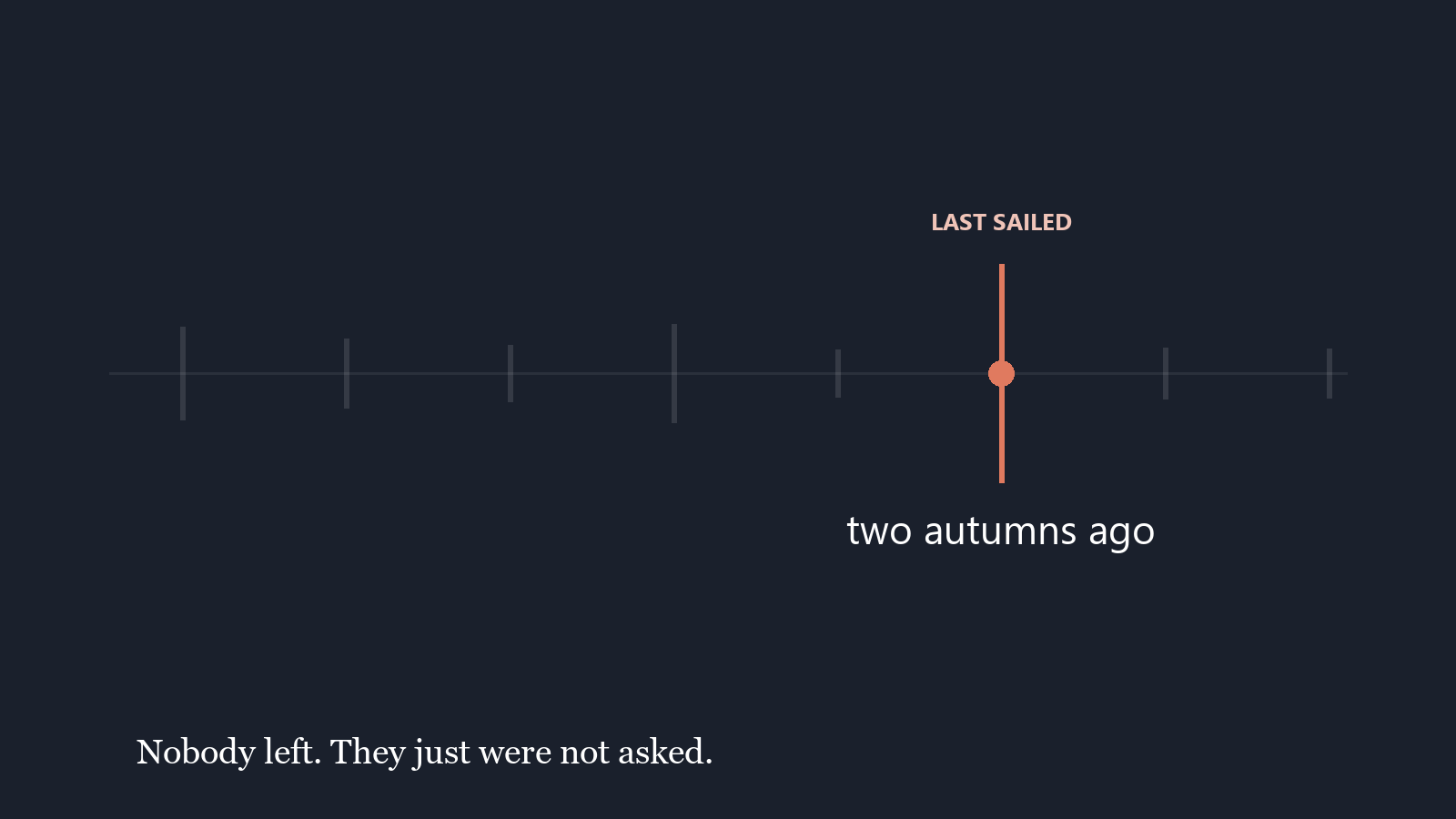
A couple sailed with you in 2023 and again in 2024. Both times they booked in the same fortnight in early autumn, both times a balcony on the same line, both times they came back delighted. Autumn 2025 passed without a booking, and so did autumn 2026.
Nothing went wrong. Nobody complained. They simply were not asked, at the moment they were used to being asked, and the habit broke.
That is the ordinary shape of lost repeat business. Not a client who leaves, but a client who lapses while nobody notices.
Repeat clients are worth more than the commission suggests
The obvious economics are that a repeat booking costs nothing to acquire. The less obvious ones matter more.
A repeat client is faster to serve because the qualifying is already done — you know the party, the preferences, the tolerance for a long flight, whether they will accept an inside cabin. The conversation starts at a recommendation instead of at a questionnaire.
They also tend to trade up. Someone on their fourth cruise is more likely to take a balcony over an oceanview, more likely to add a pre-cruise hotel night, and more likely to consider a longer itinerary. The fare rises and so does the commission on the same amount of work.
And they refer. Cruise is unusually social — people sail with friends and talk about it afterwards — so a well-kept repeat client is a source of new households rather than only of their own bookings.
None of that is available if the follow-up depends on you happening to think of them.
The signals that a client will sail again
Repeat business is not random, and the indicators are visible in booking history if the history is kept.
Cadence. Some clients cruise annually, some every two years, some twice a year. Two prior sailings establish a rhythm. The useful moment is not the anniversary of the last sailing; it is a couple of months before the point in the year when they usually book, which for cruise is often six to twelve months before they sail.
Line and ship loyalty. A client who has sailed the same line three times has told you something. Their next booking is far more likely on that line, and a loyalty tier they have earned is a reason to stay that you can use explicitly.
Party stability. A household that always travels as the same four is different from one whose party changes each time. The first can be approached with a specific sailing; the second needs a conversation first.
What they did on board. Whether they took excursions, whether they upgraded, whether they booked a future cruise while sailing. A future-cruise deposit taken on board is the strongest possible signal and the one most often lost, because it happens where you are not.
The post-cruise window is short and it is the whole opportunity
There is a period of roughly two to four weeks after a client returns when the cruise is still the thing they are talking about. In that window they will tell you what they thought in detail, they are receptive to the idea of the next one, and any dissatisfaction is still fixable rather than merely remembered.
After that the holiday recedes into ordinary life and the conversation resets to cold.
Almost nothing an agent can do has a better return than a genuine conversation in that window. It captures the preferences while they are accurate, it surfaces problems while they can still be addressed, and it is the natural moment to ask what they are thinking about next. It is also, reliably, the thing that gets skipped, because by then you are dealing with the clients who are about to sail.
Spotting a lapse requires looking, and looking requires a list
Here is the part worth being precise about, because it is where most advice becomes vague.
There is no score that tells you a client is drifting. What there is, if your records are complete, is a question you can ask: which clients have sailed at least twice, have not booked in longer than their usual gap, and have not been contacted in six months?
That query has an answer if booking history is attached to the client, if sail dates are structured, and if contact activity is recorded. It has no answer at all if the history is spread across an inbox and a spreadsheet, which is why the lapse is invisible rather than tolerated.
Travel Agent Companion keeps booking history and journeys attached to the contact, with client analytics over the same records. That is what makes the question answerable. It is worth being clear about what that is and is not: it is a way to see cadence, history and gaps, not an automated judgement that a particular client is about to leave. The work of deciding who to call is yours. What the platform removes is the need to reconstruct the list from memory before you can start.
Build the follow-up into the booking, not into your intentions
The habit that survives is the one attached to something that already has a date.
When a booking is made, set the post-cruise conversation for two weeks after the return date. It is the single highest-value contact in the relationship and it currently depends on nobody being busy in the fortnight it falls.
Then, at that conversation, ask when they think they might go again — and record the answer as a date, not as a sentiment. "Probably next autumn" becomes a task in a month you can act on.
Both of those turn repeat business from something you hope for into something scheduled. That is the entire difference between agents whose repeat rate climbs and agents whose repeat rate is whatever it happens to be.
Travel Agent Companion is free during early access. If you could not currently list the clients who have quietly lapsed, join the waitlist.