
Moving a Cruise Enquiry From First Contact to Booking
There is an enquiry in your inbox from three weeks ago. You replied the same day with a thoughtful answer and two suggestions. They said thank you and that they would discuss it. Nothing since.
That enquiry is not lost and it is not won. It is in the state most enquiries end their lives in, which is neither — and the reason it stayed there is almost never that the client decided against it.
The stages a cruise enquiry actually moves through
It helps to name them, because the unnamed version is where things stall.
Enquiry. Someone has asked. You know roughly what they want and very little about the constraints.
Qualified. You know the constraints: when they can travel, how many are going, roughly what they will spend per person, and any physical requirements. This stage is skipped more than any other, and skipping it is what produces quotes that miss.
Quoted. You have priced something specific.
Proposal sent. You have presented a recommendation with the itinerary, the categories and the terms.
Held. Space is on hold with a deadline attached. This is a real stage with a clock, not a state of mind.
Deposited. Money has moved and the booking exists.
Six stages, and the transitions between them are the job. What matters is not the taxonomy but that each stage has an obvious next action, so an enquiry can never be simply "open".
Where they stall, and it is the same place nearly every time
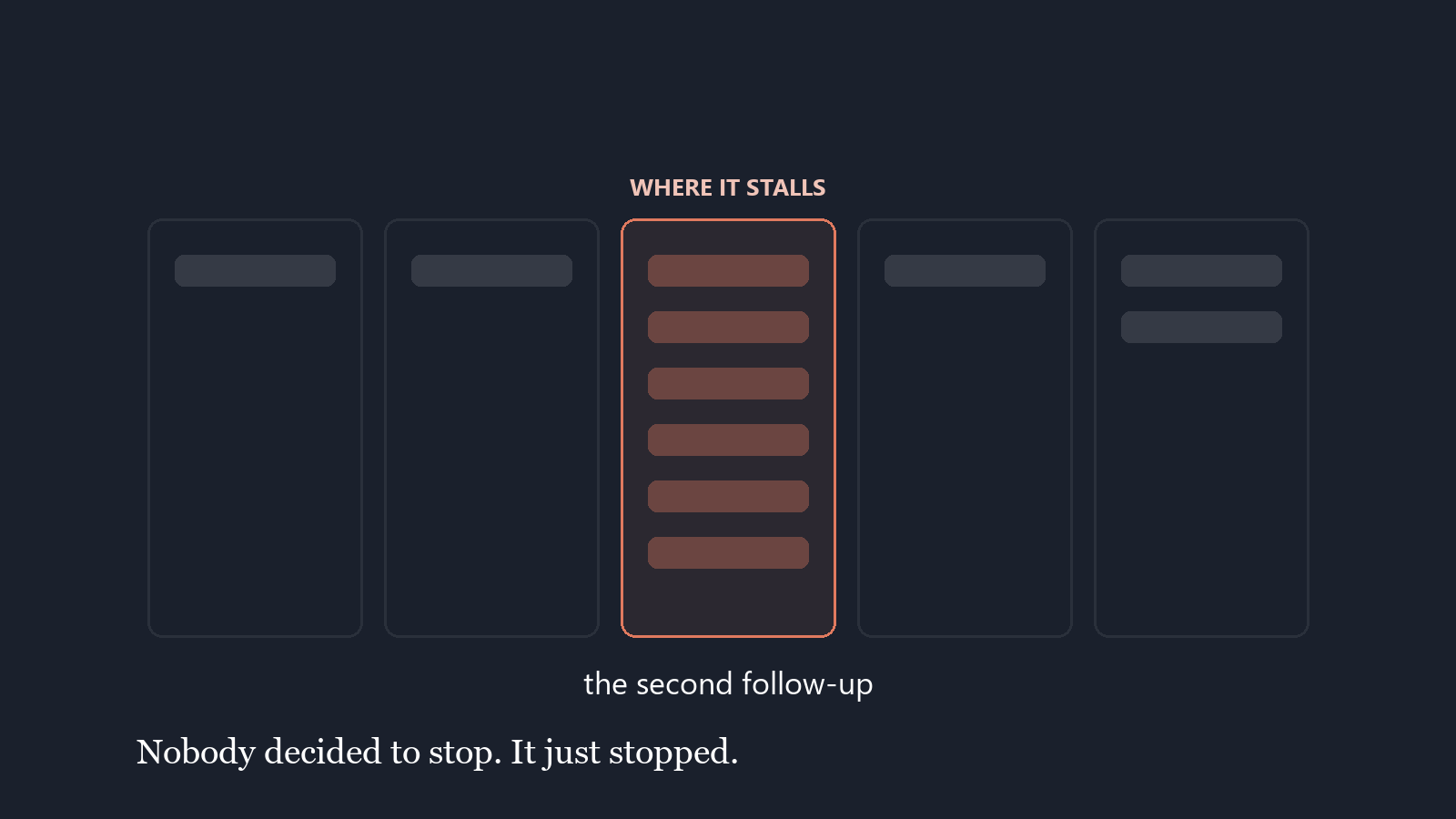
The second follow-up.
The first follow-up almost always happens. It is close to the original conversation, you remember it, and it feels like continuing rather than chasing. The second one is a week or two later, by which time the enquiry has moved down the inbox and been replaced by live bookings with deadlines attached, which are legitimately more urgent.
So the enquiry does not get rejected. It gets outranked, permanently, by work with dates on it.
That produces a particular shape of loss. You do not lose to a competitor with a better price. You lose to a client who never received a second message and eventually booked somewhere that sent one — often direct with the line, which had an automated sequence and no memory to depend on.
Qualifying questions specific to cruise
A general sales process says qualify. It does not say what to ask, and for cruise the list is short and unusually predictive.
Sail window rather than a date. "Late January to early March" is workable; "sometime next year" is not an answer you can price. The window determines which sailings exist at all.
Budget per person, not total. Cruise fares are per person with occupancy rules, so a total is ambiguous until you know the party.
Who is going, and their relationships. Two couples need different cabins from a family of four. This determines both the categories available and the number of bookings.
Prior cruise experience, and with which lines. A first-time cruiser needs a different conversation from someone with fifteen sailings and a strong view about which line's buffet they will not tolerate again.
Mobility and access. Asked early, plainly, and without embarrassment. It rules out categories, decks and sometimes ships. Discovering it after the proposal means rebuilding the proposal.
Flights, and whether they need a night before. A sailing that departs at four in the afternoon is not a sailing you can reach on a same-day long-haul, and clients rarely raise this themselves.
Six questions. They take a few minutes and they remove most of the reasons a proposal misses.
A hold is a stage with a clock, and it is treated as one
One stage deserves separate mention, because it is the one where the loss is fastest.
When space is held, there is a date attached, and the date is short — often days rather than weeks. A hold that expires quietly does more damage than an enquiry that goes cold, because the client believed something was reserved and now it is not, at a price that may no longer exist.
Holds therefore need to behave differently from every other stage. They are the one place where the deadline belongs to you rather than to the client, and where leaving the chase until tomorrow is a decision to release the cabin.
The next action has to be a property of the enquiry
Every fix for the second-follow-up problem that depends on remembering will fail, because the failure mode is not forgetfulness in general. It is that urgent dated work correctly outranks undated work, every time, forever.
So the answer is to give the undated work a date. The next action on an enquiry — call, send the second option, check whether the hold is about to expire — needs to be a field on the enquiry, with a date, visible in the same place you look at everything else that is due.
That is the entire mechanism, and it is why a pipeline is worth more than a folder. A folder tells you what exists. A pipeline tells you what is waiting on you and since when.
Travel Agent Companion holds enquiries in a lead inbox with capture templates and scoring, moving through quote and workflow phases into bookings, with email sequences for the follow-ups that should not depend on anyone remembering. Lead analytics show where enquiries actually stop, which is usually not where people assume.
That last point is worth acting on before buying anything. Take last quarter's enquiries and mark which stage each one died at. Most agents expect the answer to be price. It is usually silence, at the second contact, and that is a much cheaper problem to fix.
Travel Agent Companion is free during early access. If your enquiries live in an inbox with no next action, join the waitlist.