

Hotels moved into ChatGPT. What it changes for the agent in the middle.
A client emails on a Sunday to say they have sorted the two nights in port before the sailing. They found the hotel themselves, in a chat window, and they are pleased about it. The stateroom is still yours to book. The rest of the trip is quietly being assembled somewhere you cannot see.
That is not a forecast. It is a description of something that shipped in the last week of July.
What the hotel groups actually launched
On 28 July 2026, Radisson Hotel Group put an app inside ChatGPT. A traveller opens a conversation, names the app, and describes what they want in ordinary language — a family-friendly weekend in Amsterdam, or somewhere in Paris with a gym and a spa near the Eiffel Tower. The app answers with matching properties, live inventory and rates, amenities, and a map. Then it hands the traveller to Radisson's own site to complete the reservation. It covers more than 1,000 hotels across over 100 countries, and it was built with Accenture (announcement).
G6 Hospitality had done the same thing with Motel 6 the day before, across roughly 1,500 economy properties in the United States and Canada. Two groups in two days is a pattern rather than an experiment.
Note the one thing neither of them does: take the payment.
A hotel group does this for the commission, not the novelty
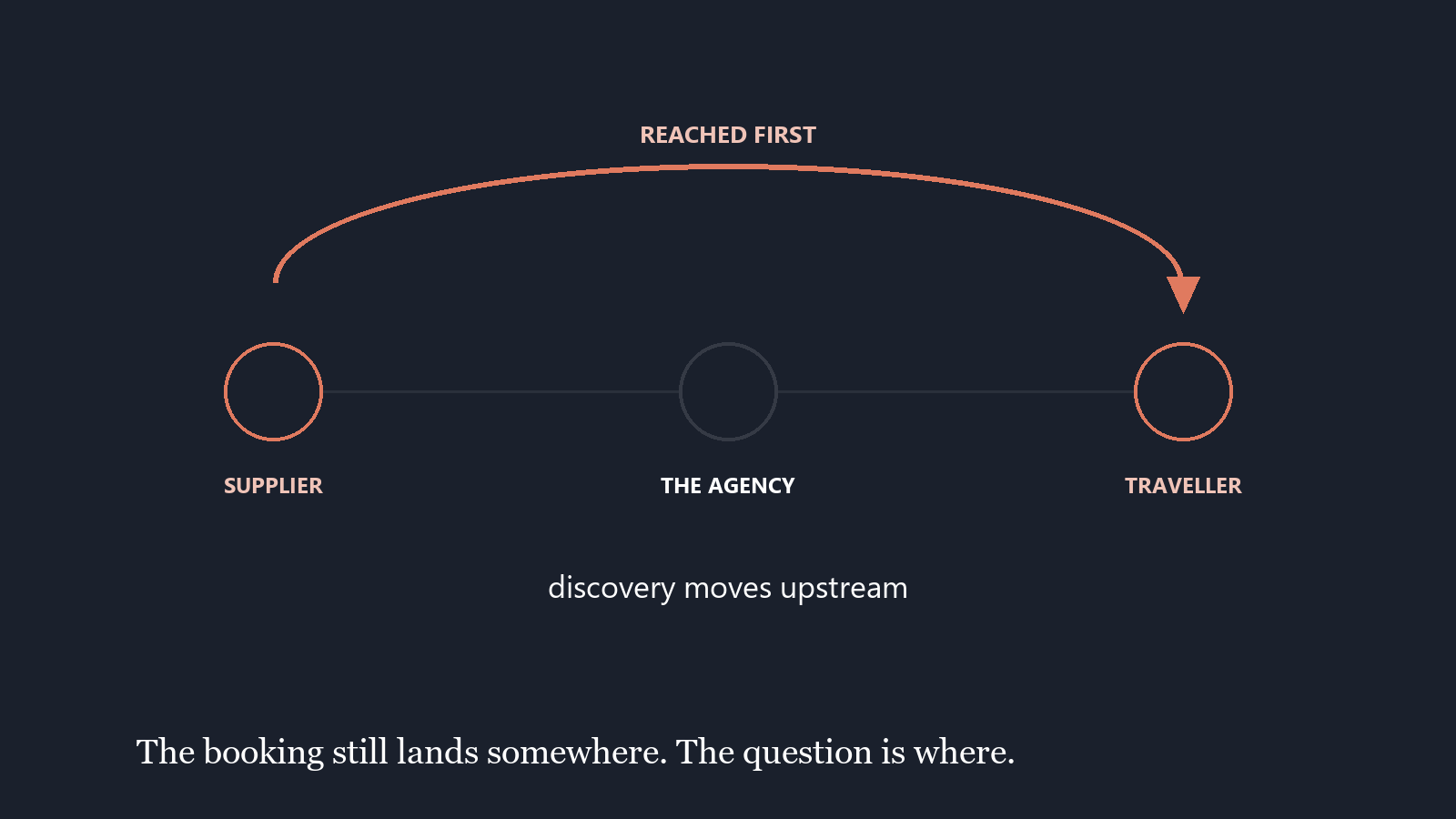
Hotels have paid commission to online travel agencies for about twenty years, and have argued about those fees for most of that time. An app inside the assistant is a way to meet the traveller earlier than the agency can — as one account of the launches put it, "a way to reach the traveller before the agency does, then close on the hotel's own site at the hotel's own rate" (The Next Web).
Radisson's own framing is a direct-booking strategy, not a marketing channel. The release is candid about why the urgency: organic and direct web traffic, the channels that have historically driven online bookings, "are giving way to new touchpoints like ChatGPT."
So this is a supplier reaching past the people who sell for it. An independent agent is one of those people. It is worth being plain about that rather than reading it as a story about technology.
The coverage framed the choice facing brands as becoming "the agent of choice" or settling for being "the choice of agents." In that sentence "agent" means software. Read it with the other meaning and it describes your position exactly: whoever is not chosen at the moment the client forms an intention does not get a second chance further down the funnel.
What it does not reach
Two things, and both are worth holding onto.
The first is the transaction. Accenture's own consumer research found that 32% of people would let an assistant decide what to buy, and 9% would accept fully autonomous purchasing; payments, in their words, remain the biggest barrier. That is why discovery happens in the chat and checkout happens on the supplier's website. Treat that boundary as a sequencing decision rather than a principle — Radisson lists in-chat booking, reservation management and an AI concierge as planned, not as declined.
The second is loyalty, and here the same research cuts against the suppliers. Accenture reports that 90% of frequent AI users in North America would abandon a brand they previously preferred if their assistant suggested something better. The surface that carries a hotel past its intermediaries also puts it up for re-comparison on every single request. Being in the chat is not a moat. It is a way of not being absent.
The thing an assistant does not have
An assistant answering a question about Amsterdam knows what is available and what it costs. It does not know that this client has sailed the same line three times, that they will not take a stateroom above the theatre again after last year, that they travel with a sister who needs an adjoining cabin, or that the group they organised in 2025 nearly came apart over a deposit deadline nobody had written down.
That is not a small gap. It is the entire difference between a list of options and a recommendation someone trusts. And it does not live in a chat window — it lives in whatever record you keep of the clients you have sold to.
Which raises an uncomfortable question about where that record actually sits. For a great many agents it sits partly in a spreadsheet, partly in an inbox, and partly in a CRM that belongs to the host agency.
Where the record lives, and who holds it
Travel Agent Companion is built so that the book of business is on the agent's side of that line. Contacts, booking history and commission records are exportable in full, and they are not held by a host agency. Isolation is per agency and never pooled, which is what makes changing host agencies something other than starting over.
The data model underneath is cruise-native rather than a hotel booking with extra fields: cruise lines, ships, itineraries, ports of call, sail dates and stateroom categories are first-class records, not custom fields bolted onto something generic. That matters here for a specific reason — the details that make your recommendation better than an assistant's are exactly the details a hotel-shaped system has nowhere to put.
None of this stops a supplier from appearing in a chat window. Nothing will. What it does is make sure that the part of the business that cannot be automated away is written down, in your possession, and still yours the day your host agency arrangement changes.
The platform is free during early access. If that is the part of your business you would rather not leave in a spreadsheet, join the waitlist.